
TEACHABLE MOMENTS | OCTOBER 24, 2022
X-Ray Vision and Polarized Glasses Unite to Uncover Mysteries of the Universe
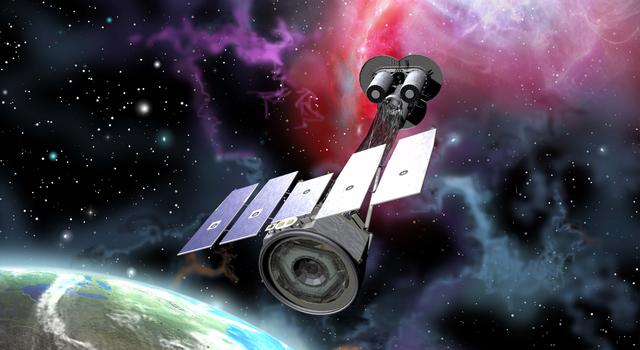
A NASA space telescope mission is giving astronomers a whole new way to peer into the universe, allowing us to uncover long-standing mysteries surrounding objects such as black holes. Find out how it works and how to engage students in the science behind the mission.
Some of the wildest, most exciting features of our universe – from black holes to neutron stars – remain mysteries to us. What we do know is that because of their extreme environments, some of these emit highly energetic X-ray light, which we can detect despite the vast distances between us and the source.
Now, a NASA space telescope mission is using new techniques to not only scout out these distant phenomena but also provide new information about their origins. Read on to learn how scientists are getting exciting new perspectives on our universe and what the future of X-ray astronomy holds.
How It Was Done
The Imaging X-Ray Polarimeter Explorer, or IXPE, was launched by NASA in 2021 as a result of a partnership between Ball Aerospace and the Italian Space Agency. In order to detect X-rays emitted by very powerful celestial phenomena like black holes, various types of neutron stars (such as pulsars and magnetars), and active galactic nuclei, the space telescope is scheduled to run for two years. The telescope is concentrating on about a dozen previously studied X-ray sources in its first year, spending hours or even days viewing each target to uncover new data made available by the scientific instruments on board the spacecraft.
The X-ray telescope IXPE is not the first to study the universe. Launched by NASA in 1999, the Chandra X-ray Observatory is renowned for having spent more than 20 years taking pictures of the universe.
at a wavelength of light that is unique to high-energy conditions, such as those in which cosmic materials are heated to millions of degrees by strong magnetic fields or strong gravity.
The various energy levels, or wavelengths, produced by these habitats can be assigned colors using Chandra. This enables us to see the tremendously energetic light that black holes and smaller neutron stars—small, incredibly dense stars with masses 10–25 times that of the Sun—eject into space. These stunning pictures, like as those from Cassiopeia A (abbreviated Cas A), Chandra's first target, depict the violent beauty of stars exploding.

Where do the majority of the components needed for Earthly life originate? The solution is found within stellar furnaces and the explosions that herald the death of some stars.
To learn more about how stars form and subsequently distribute many of the elements found on Earth and across the universe, astronomers have long studied exploding stars and their remnants, or "supernova remnants."
Cassiopeia A (Cas A) is one of these supernova leftovers that has been the subject of the most research due to its distinct evolutionary state. The locations of various elements in the explosion's remnants are depicted in a new image from NASA's Chandra X-ray Observatory: silicon (red), sulfur (yellow), calcium (green), and iron (purple). Each of these substances emits X-rays in specific confines. Using energy ranges, maps of their location can be made. The blue outer ring is the blast wave from the explosion.
Because supernovae emit temperatures of millions of degrees even thousands of years after the explosion, X-ray telescopes like Chandra are crucial for studying supernova remnants and the components they produce. As a result, a lot of supernova remnants, including Cas A, are most brightly illuminated at X-ray wavelengths that are invisible to other kinds of observatories.
Astronomers may learn in-depth details about the elements that objects like Cas A create thanks to Chandra's acute X-ray vision. They can, for instance, not only tell what many of the elements are but also how much of each is being ejected into interstellar space. The Chandra measurements show that Cas A's supernova produced enormous quantities of essential cosmic components. Sulfur alone has been distributed in amounts equivalent to 10,000 Earth masses, and silicon amounts to 20,000 Earth masses. Astronomers have discovered a staggering one million Earth masses of oxygen being ejected into space from Cas A, which is comparable to around three times the mass of the sun. The iron in Cas A has a mass that is approximately 70,000 times that of the Earth. (Even though oxygen is the most abundant element in Cas A, it is not separated in this image because its X-ray emission is dispersed across a wide range of energies, unlike the other atoms that are seen.)
Astronomers have located additional elements in Cas A beyond those depicted in this fresh Chandra picture. Using various telescopes that focus on various wavelengths of the electromagnetic spectrum, carbon, nitrogen, phosphorus, and hydrogen have also been found. This indicates that Cas A contains all of the components required to create DNA, the molecule that carries genetic information, along with the finding of oxygen.
About 65% of the mass of the human body is made up of oxygen, which also helps to create and maintain strong bones and teeth. Iron is an essential component of red blood cells, which transport oxygen throughout the body. Massive stars that have exploded are the sole source of oxygen in the Solar System. 40% of the iron and around 50% of the calcium also come from these explosions, with the remaining portions of these elements coming from explosions of white dwarf stars with lower masses.
Many researchers believe that the stellar explosion that produced Cas A took place around the year 1680 in Earth's time, though the exact date has not been determined. The dying star had a mass that was roughly five times that of the Sun moments before it erupted, according to astronomers. A powerful wind that was blowing off the star several hundred thousand years before the explosion is thought to have stripped the star of around two-thirds of the mass that it had at the beginning of its life—about 16 times that of the Sun.
The star's core started fusing hydrogen and helium into heavier elements earlier in its life. the "nucleosynthesis" procedure. The star's resistance to gravity was maintained by the energy created by the fusing of more and heavier elements. These reactions persisted until iron was produced in the star's core. Gravity subsequently led the star to implode and create a dense stellar core known as a neutron star because additional nucleosynthesis at this point would consume rather than produce energy.
However, the infalling material outside the neutron star was eventually transformed by additional nuclear reactions as it was expelled outward by the supernova explosion. The precise mechanism by which a massive explosion is produced after the implosion is complicated and the subject of intense study.
Considering that the observatory was sent into orbit, Chandra regularly observed Cas A. in 1999. New facts regarding the neutron star in Cas A, the nature of the explosion, and how the debris is launched into space have been discovered by the various datasets.
For NASA's Science Mission Directorate in Washington, the Chandra program is managed by NASA's Marshall Space Flight Center in Huntsville, Alabama. The science and flight activities of Chandra are managed by the Smithsonian Astrophysical Observatory in Cambridge, Massachusetts.
NASA/CXC/SAO credit for the image